


Disclaimer
This AI-assisted report is for informational and educational purposes only. It is not medical advice, diagnosis, or treatment. The intent is to point out red flags on the marketing of this product, not the product itself. Do your own research prior to purchasing any supplement or health product.
People can make better health decisions when the signal is separated from the sales pitch.
Opening hook
If your feed has served you a video about an Amish family who supposedly discovered a “black garlic secret” that oncologists are afraid to talk about, you are looking at one of the more polished supplement funnels running right now. The ingredient at the center of it, aged garlic extract, is not fake. It has decades of actual research behind it. But the story wrapped around it, and the promises made on top of it, are a different matter entirely.
What is being sold
The product is aged garlic extract in softgel form, usually described as “odorless” and equivalent to 7,500 mg of garlic per capsule after a claimed aging process that the company’s own materials describe inconsistently, citing figures ranging from 24 to 730 days. The best documented example is Elaré Aged Garlic Extract, sold through an advertorial landing page and Facebook ads, but the same script shows up under multiple brand names, including Resilia Aged Garlic, Aali (also seen as AAR, tied to a company called Fitactic), and products sold through primus-health.com (Elaré advertorial; Elaré product page).
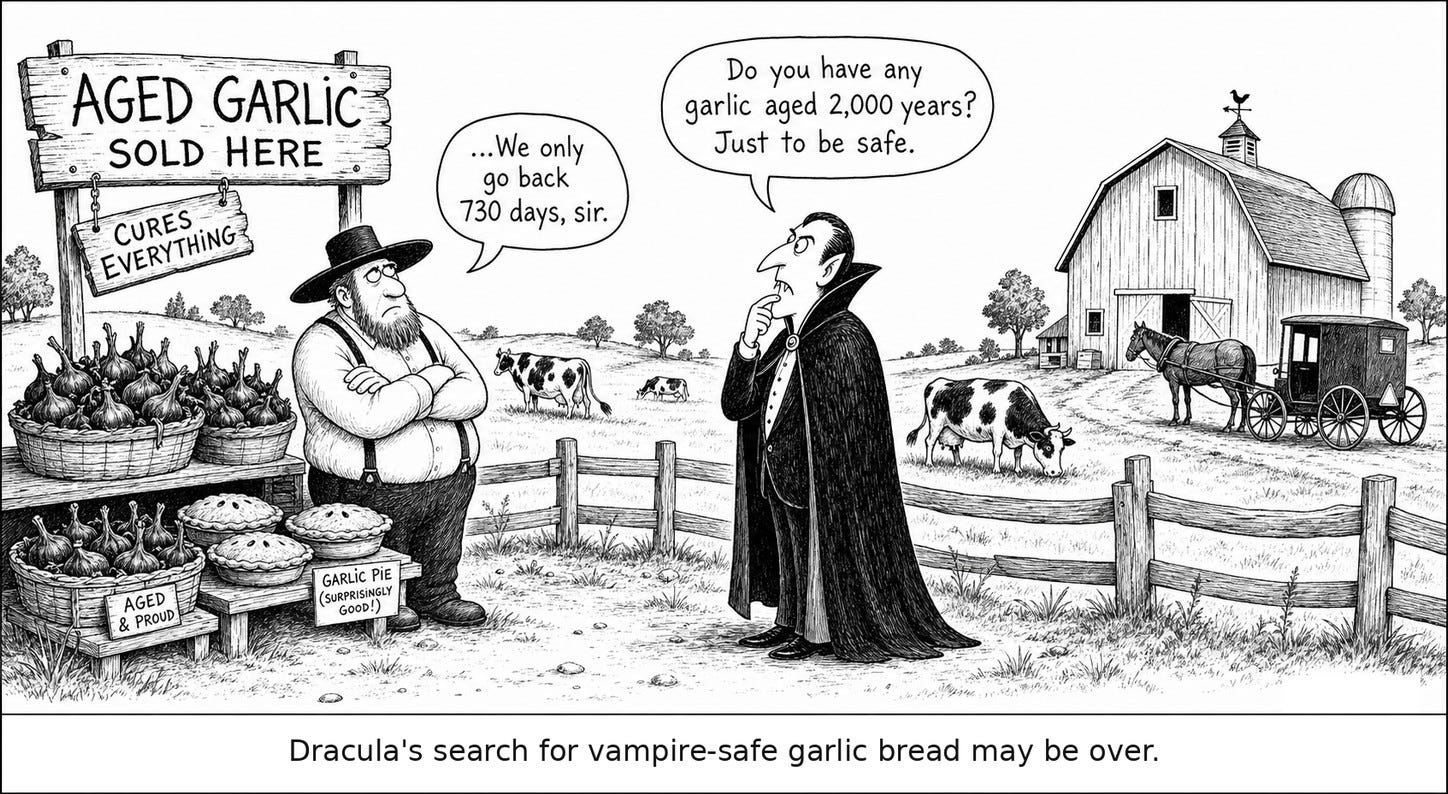
The core pitch: an Amish family in Lancaster County, Pennsylvania supposedly stored garlic in barn cellars for two years, discovered it turned black and lost its harsh compounds, and passed the technique down for two centuries. The advertorial says this “Amish aging process” produces S-allyl-cysteine (SAC), a real compound found in aged garlic, and claims it is “30 times less toxic” and “nearly 100% bioavailable,” reduces C-reactive protein by 50 to 70 percent, and “changes your cellular environment so cancer can’t grow in the first place” (Elaré advertorial).
Why it may appeal
Garlic and honey home remedies have circulated in Amish and Mennonite communities for generations, and there is a real, peer-reviewed reason the “Amish” framing lands: a 2009 Ohio State University study found that Amish adults in Holmes County had cancer rates about 40 percent lower than the surrounding population, a genuine and widely reported finding (Cancer Causes & Control; Ohio State).
People are also right to be tired of garlic breath, and a supplement that promises the benefits without the smell is a reasonable thing to want. On top of that, distrust of a profit-driven medical system is not irrational, and a “the doctors don’t want you to know” narrative taps into something real for a lot of people managing chronic conditions on their own.
Red flags spotted
Disease-cure and cancer-prevention framing. The advertorial states the product delivers “cancer prevention results” and “changes your cellular environment so cancer can’t grow.” That is a disease-prevention claim for a dietary supplement, the exact category of language that draws FDA and FTC warning letters.
A real statistic attached to an unrelated cause. The “40% lower cancer rates” figure is genuine Amish epidemiological data, but the original researchers attributed it to low tobacco and alcohol use, physical labor, and possibly genetics, not garlic. The 2009 study does not mention garlic at all (Cancer Causes & Control). Attaching a real number to an unstated cause is a classic evidence-laundering move.
A misattributed institutional reference. Ads and reviews reference “Stanford research” behind the claims. Stanford Medicine’s actual completed study on garlic supplements, including Kyolic aged garlic, found no statistically significant effect on LDL cholesterol (Stanford Medicine). If this is the study being invoked, it undercuts the pitch rather than supporting it.
“Unverifiable expert quotes. The page attributes strong claims to “Dr. James Harrison, oncologist at Mayo Clinic” and “Dr. Jason Peterson, MD, Cardiologist, Austin Heart Center.” Neither name appears in Mayo Clinic’s or Austin Heart’s public physician directories, nor in a search of state medical licensing boards, as of July 2026. This does not prove the quotes are fabricated, but the named credentials cannot currently be verified through any public record.”
An unverifiable origin story. A search of Pennsylvania’s business entity database — the state where the Amish-farm origin story is set — turned up no company registered under the Elaré name, nor any entity called Fitactic, the manufacturer an independent product investigation linked to the related “Aali” brand on Amazon (Savage Reviews), as of July 2026. Independent scam-detection services have separately flagged the site: ScamAdviser gives elare.store a trust score of 7 out of 100, citing a hidden site owner among the risk factors, and a separate analysis rated it 1 out of 100 (ScamAdviser; Gridinsoft). Multiple customer reviews on Trustpilot independently report packages shipped from China despite “American-made” marketing claims, and a separate investigation found the same aged-garlic formula sold under at least one other brand name, “Aali,” manufactured by Fitactic (Trustpilot: elare.store; Snoopviews; Savage Reviews).
Testimonial-heavy persuasion with dramatic biomarker numbers. The page is built around anecdotes citing specific PSA drops, “zero new polyps,” inflammation markers falling 58 to 64 percent, and mammograms coming back clear, the kind of precise, dramatic before-and-after detail that is easy to write and hard to verify.
Subscription and refund complaints. Elare’s Trustpilot page shows an overall rating of 2.1 out of 5 (”Poor”) across 316 reviews, with 72 percent being one-star. Filtering reviews by Trustpilot’s own “Subscription” tag returns roughly 50 reviews describing being enrolled in recurring subscriptions without clear consent or struggling to cancel — a pattern substantial enough that Trustpilot’s own AI-generated review summary independently flags “unexpected monthly subscriptions and difficulties in stopping future orders” as a recurring theme. This runs counter to marketing pages advertising a straightforward 30-day money-back guarantee (Trustpilot: elare.store).
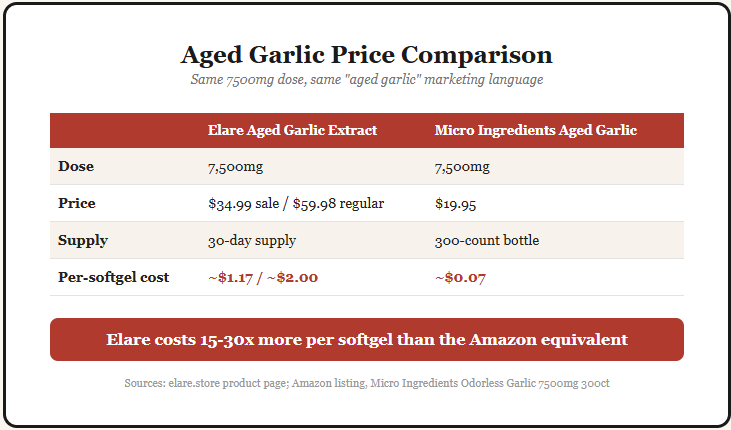
Price gaps between the funnel and the open market. A price comparison found Elaré’s Aged Garlic Extract selling for $34.99 (marketed as a discounted price from $59.98) for a 30-day supply of 7500mg softgels. A comparable 7500mg, similarly aged garlic softgel sold on Amazon under the Micro Ingredients brand costs $19.95 for a 300-count bottle — roughly 15 to 20 times cheaper per softgel at Elaré’s sale price, and closer to 25 to 30 times cheaper at Elaré’s listed regular price (Elare.store; Amazon).

A repeating template across brands. Elaré, Resilia, and Aali/AAR all use nearly identical structure: odorless claims, an Amish or folk-origin story, softgel counts marketed in “months of supply,” and a near-identical testimonial format. That pattern suggests a shared funnel or white-label supply chain rather than independent companies each discovering the same secret.
What evidence exists
Aged garlic extract itself is a legitimate, well-studied supplement category, distinct from the marketing built on top of it. Kyolic, the original branded aged garlic extract, has been manufactured for decades and is the subject of the bulk of the published research (Kyolic).
For blood pressure, a randomized, placebo-controlled trial in patients with uncontrolled hypertension found that aged garlic extract lowered systolic blood pressure by an average of about 5 mmHg across all participants over 12 weeks. That average includes a mix of people who responded strongly and people who barely responded at all; when researchers looked specifically at the “responder” subgroup, those individuals saw a larger drop of roughly 11.5 mmHg. Both numbers come from the same study and aren’t in conflict, they’re just describing different slices of the same data (Integrated Blood Pressure Control). The realistic takeaway is a modest, real effect on average, with a stronger effect for people who happen to respond well.
For cancer, the evidence is thinner and more mixed than the marketing suggests. A small randomized trial found aged garlic extract reduced the size and number of precancerous colorectal adenomas over 12 months in surgical patients, which is a genuine and interesting finding, but it is about precancerous polyps in a specific patient group, not cancer prevention or reversal in general (J Nutr).
A broader systematic review of aged garlic and cancer found the human evidence inconsistent, while animal and lab evidence was more consistent, and concluded that more research is needed before recommending aged garlic as part of a cancer prevention program (International Journal of Preventive Medicine). Most of the strongest anti-cancer findings for garlic compounds come from cell and animal studies, where achievable concentrations do not match what the body absorbs from a capsule.
For the underlying compound claims, an in vitro lab study did find aged garlic extract had stronger antioxidant and antiglycation activity than fresh garlic, a real and interesting finding, but the researchers themselves noted it was a cell-free lab experiment and said more work was needed to see whether it holds up in the body (PMC).
What remains unclear or unproven
There is no published clinical trial showing that this specific product, or aged garlic extract generally, prevents cancer or reverses it in humans. The C-reactive protein reduction of 50 to 70 percent cited on the page is not matched to a specific study in the marketing material. Independent testing has also found that garlic supplement potency varies widely across the market in general, with at least one tested brand containing no detectable garlic compounds at all, though that finding was not about this specific product line (ConsumerLab).
Whether this brand’s SAC content matches what was used in the clinical research is not disclosed on the label information reviewed. The Amish origin story, the named physicians, and the claimed 730-day aging process— the high end of the inconsistent range noted above — are also not independently verifiable from anything published outside the company’s own marketing.
Risk rating: Aged Garlic Marketing Funnels
Extreme concern.
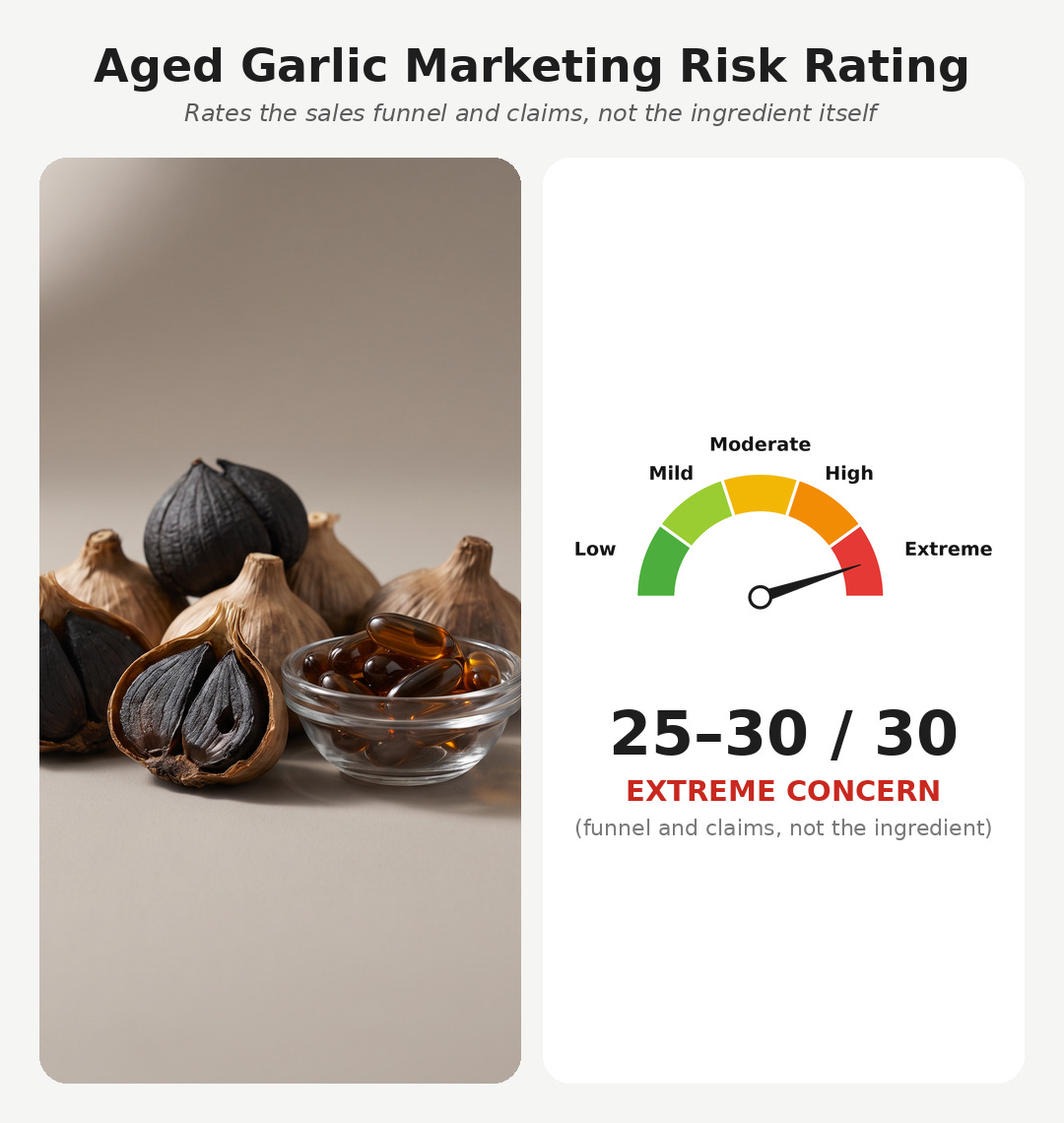
The Health Claim Risk Rubric scores ten categories, each rated 0 to 3 points, for a maximum possible total of 30: claim severity, evidence quality, scientific honesty, authority signals, testimonial dependence, language manipulation, offer structure and pricing, regulatory risk signs, network amplification suspicion, and missing essentials. A total of 0 to 5 reads as Low concern, 6 to 11 as Mild, 12 to 18 as Moderate, 19 to 24 as High, and 25 to 30 as Extreme.
This case landed at the top of that scale mainly because of high scores in claim severity (explicit cancer-prevention and disease-outcome language), authority signals (physician quotes and a research citation that could not be verified), and offer structure and pricing (subscription and refund complaints sitting under a “no questions asked” guarantee).
This score could improve if the seller published third-party lab verification of SAC content matching clinical research doses, disclosed a real manufacturing address, and dropped the disease-outcome language. It would look worse with a broader look at more Facebook ad variants and any FTC action history for the entities involved.
Bottom line
Aged garlic extract is a real supplement with real, modest research behind it for things like blood pressure and inflammation markers. What is being sold here is a good ingredient wearing a costume. The Amish barn story cannot be verified, the physician quotes cannot be verified, the referenced Stanford research appears to point the other way, and the cancer claims go well beyond anything published.
That does not mean nobody benefits from taking the capsules. It means the marketing outruns the proof by a wide margin, and the story exists to make you stop asking questions rather than start.
Reader prompt
Have you seen one of these “Amish garlic” ads, or bought one of these products? Did your experience match what is described here? If you take an aged garlic supplement, which brand, and how did you land on it? And what should the next Daily Red Flag Report look at?