


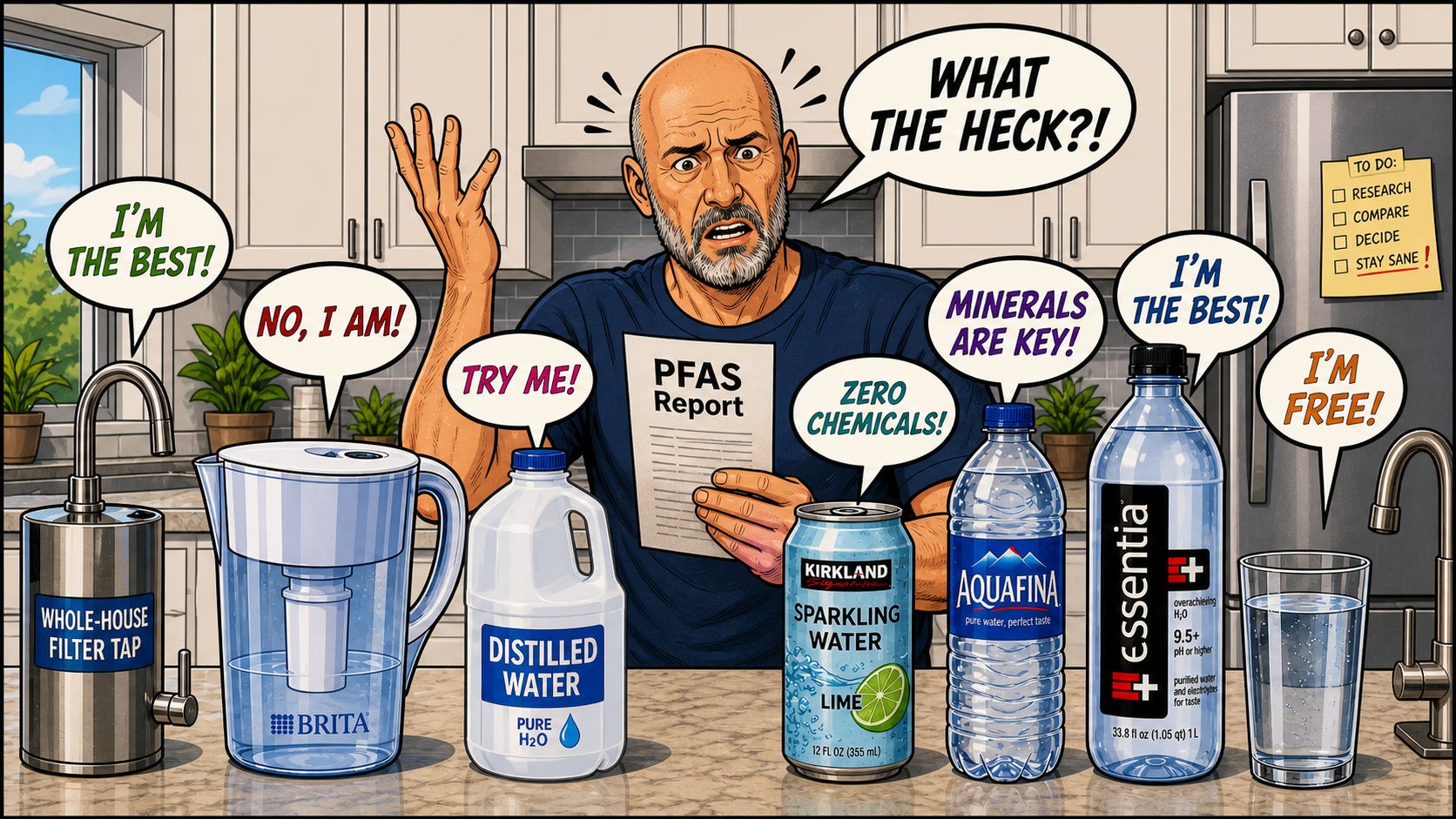
Part 1: I Found Forever Chemicals in My Blood. And so the investigation began.
Here’s something I found out the hard way: I had PFAS in my blood.
Not from living near a factory. Not from some unusual exposure. Just from being alive in Florida and drinking water for decades like a normal person.
Turns out, I’m not alone in being concerned. A 2025 poll found that clean water beat out inflation and healthcare reform as the top issue Americans worry about. Four in ten Americans now distrust their tap water entirely. One in four won’t drink it at all.
And the fear is evolving. Lead has been the #1 contaminant concern for years — but in the last two years, something shifted. Microplastics concern jumped 400% since 2023, now ranking #4 among top water fears. PFAS moved up to #3. Both are in most tap water in the U.S. — and most treatment facilities aren’t removing them.
What are PFAS? Per- and polyfluoroalkyl substances are a class of chemicals used in manufacturing since the 1940s. They’re in nonstick cookware, food packaging, firefighting foam, and yes, most municipal water systems. They break down so slowly they’ve earned the nickname “forever chemicals,” and they can linger in the human body for years after exposure.
Research has linked PFAS to increased cholesterol, thyroid disruption, reduced vaccine response in children, and elevated cancer risk — specifically kidney and testicular cancers.
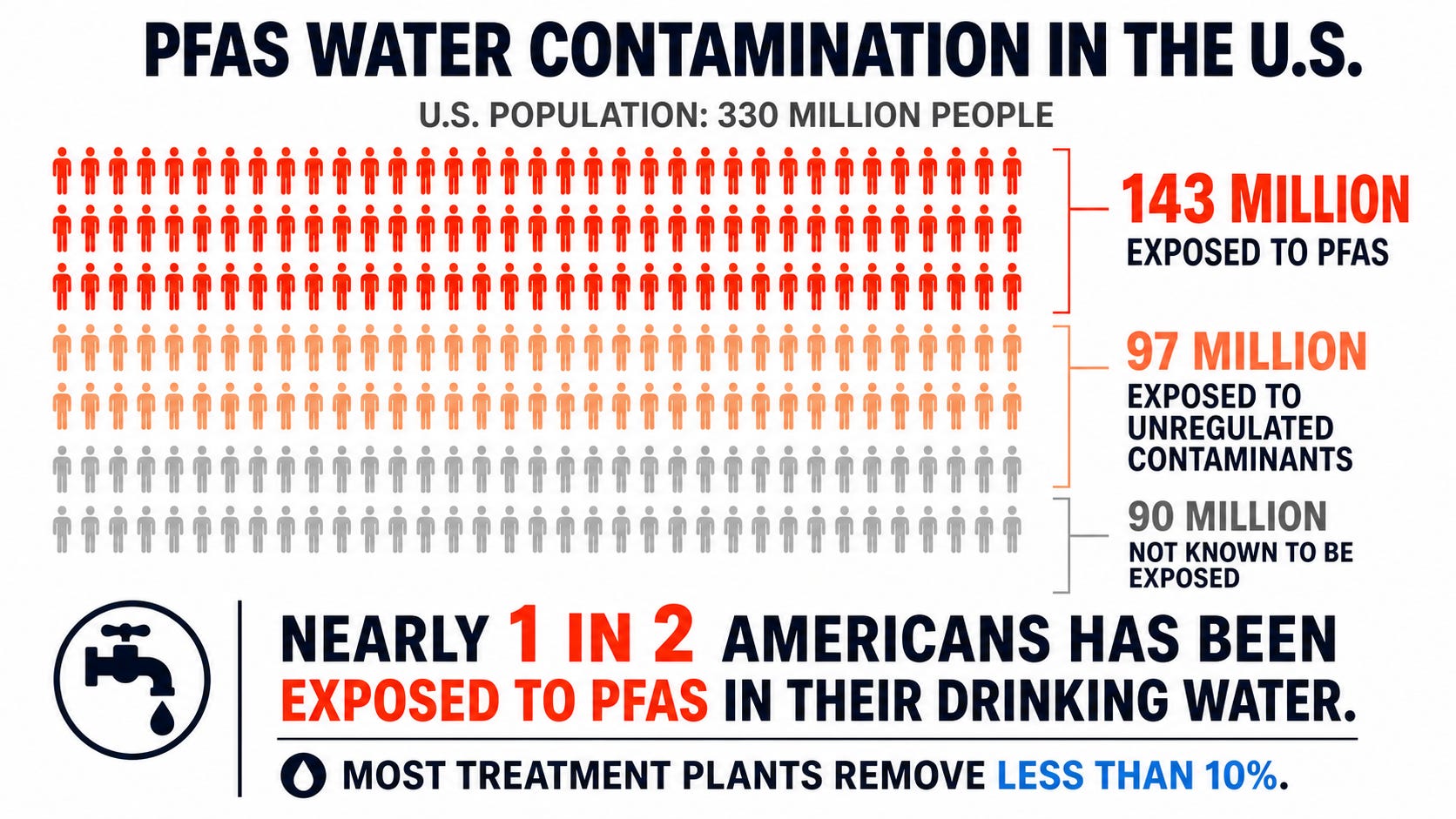
The scale is hard to wrap your head around. Nearly 97 million U.S. residents have been exposed to unregulated contaminants in their drinking water. Over 143 million people have been exposed to PFAS specifically. University of Florida research published in early 2025 found contamination throughout Florida’s water systems — and most municipal treatment facilities currently remove less than 10% of PFAS before the water reaches your tap.
The EPA only finalized enforceable limits for six PFAS compounds in 2024. Florida public water systems don’t have to comply until 2029. That’s a long runway while the chemicals keep accumulating.
Most people’s response to all of this is either do nothing or spend $3,000 on a whole-house filtration system. There isn’t much conversation about what’s in between.
So that’s the real question this series is asking — not just “which water tastes better?” but how does your body actually respond to the water you’re already drinking, and is there a smarter, more accessible path forward?
That’s right about the time I got an opportunity to test a whole house filtration system.
Enter: The $3,000 Water Filtration System
My brother went out of town and asked me to housesit. Standard stuff — water the plants, don’t burn the place down.
What I didn’t expect was to spend most of the week obsessing over his water.
He’d installed a whole-house filtration system a while back. The setup runs around $3,000 installed. He swears by it. I was skeptical in the way you’re skeptical of anything expensive that you can’t directly see working.
So I decided to test it — against his filtered water, tap water, a few bottled options, and sparkling water from Costco. Seven water sources total. And I didn’t just taste them. I scanned my body’s response to each one using bioresonance scanning, the same non-diagnostic tool we use at Crunchy Nation to look at energetic patterns across body systems.
The Test Setup
Seven water sources. One body. Bioresonance scanning before and after each.
The waters tested:
My brother’s filtered tap (the $3,000 system)
Straight municipal tap
Brita-filtered tap
Distilled water
Costco sparkling water
A name-brand still bottled water
A re-mineralized alkaline water
Each one was assessed for body response patterns across key systems — digestion, lymph, stress markers, and overall energetic coherence. Nothing diagnostic. Think of it as the body’s own feedback signal on its environment.
What the Scan Showed
The results were genuinely surprising.
The $3,000 filtered water performed well — better than straight tap in most markers, which you’d hope for at that price point. But it wasn’t the top performer across the board.
Distilled water scored the worst. Repeatedly. Despite being the “cleanest” water chemically, the body appeared to respond to it like something was missing — which makes sense, because minerals are stripped out in the distillation process along with the contaminants.
The Costco sparkling water? Unexpectedly strong showing. Better than two of the bottled options and within range of the filtered tap on several markers.
The re-mineralized alkaline water also performed well — and that result became relevant when I started thinking about what Part 2 should look like.
So Where Does That Leave Us?
A $3,000 whole-house system is out of reach for most households. Bottled water is expensive, wasteful, and — as the scan data suggested — not necessarily better for your body than what’s coming out of your tap. And your tap water, depending on where you live, is carrying decades of chemical baggage that most treatment plants aren’t removing.
That’s a frustrating place to land. But it’s also where the more interesting question starts.
One of the things the scan data pointed toward was that mineralization matters — not just filtration. The worst performers were the waters with the least mineral content. The best performers had something added back in. That pattern made me want to test something specific: what happens when people add a concentrated mineral supplement to whatever water they’re already drinking? No new filter. No new water source. Just an upgrade to what they have.
That’s what Part 2 is — and I want to do it right, with real people and before/after scans.
If you’re in the Clearwater area or nearby and want to be part of the experiment, hit the Message button below. You’d come in for a free bioresonance scan on your current water, try the mineral supplement for a set period, then come back for a follow-up scan. No cost to you. Your data stays anonymous in the article.
As a byproduct, you’ll also receive a full bioresonance scan of your body’s key organ systems — a $50 value — yours free just for participating. I’m looking for 10–15 people across different water situations — tap drinkers, bottled water loyalists, filtered water users.
Part 2 won’t happen without participants. If you’re local to Clearwater and would like to participate, let me know. Click the button below to DM me.
A note on methodology: This is not a toxin removal study. I’m not measuring what’s in the water — I’m measuring how the body responds to it using bioresonance scanning, a non-diagnostic tool. Results represent energetic response patterns, not clinical diagnostics.