


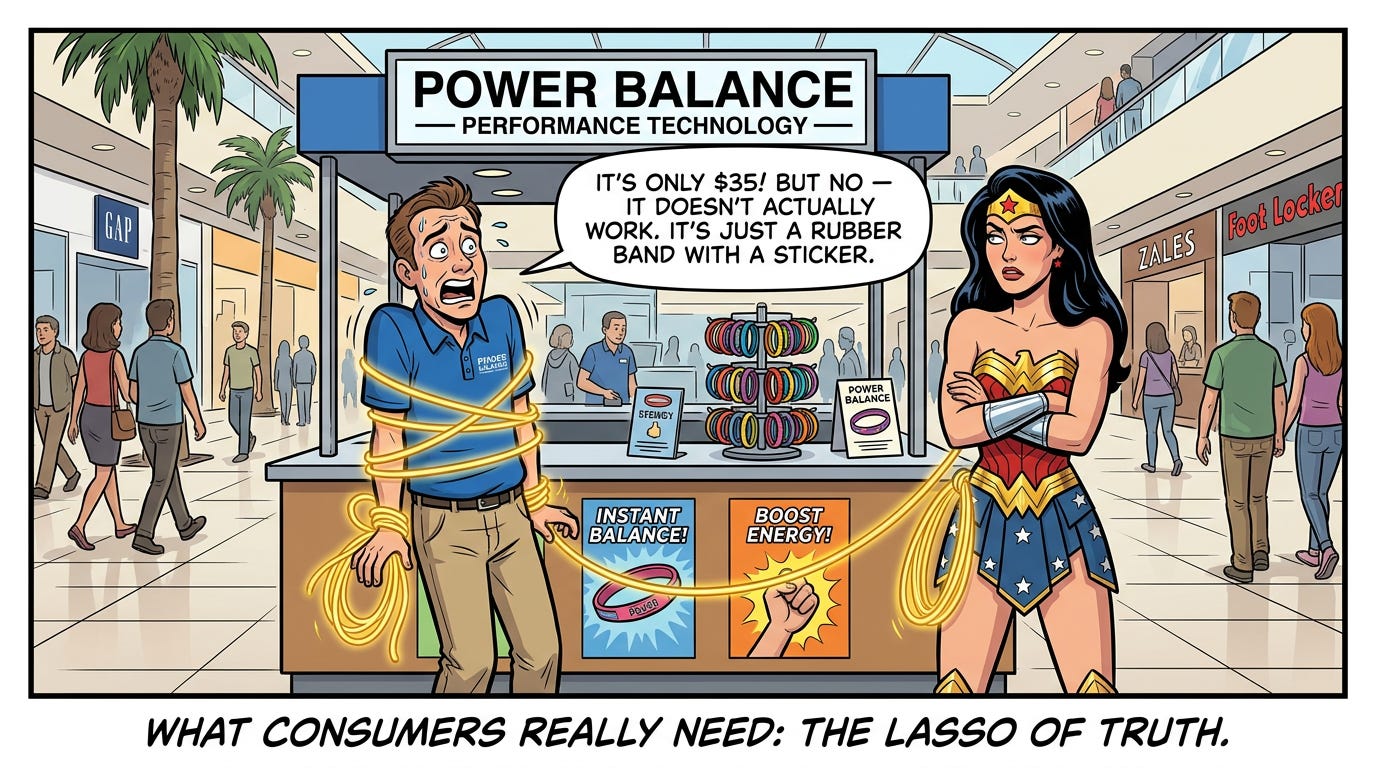
I actually bought one of these bracelets years ago. Forgot all about them. I wore it for months. Never noticed a difference. Now I know why. It sat in a junk drawer for years.
Risk Rating: High Concern
This is an AI-assisted red flag report designed to surface possible concerns and open questions. It is meant to help readers think more clearly, not to do their thinking for them.
Opening Hook
The salesperson asks you to stand on one leg. You hold out your arm. They push down on your wrist, hard. You stumble.
Then they slip a thin rubber bracelet onto your wrist. You stand again. They push. This time you hold.
You just paid thirty dollars for a piece of silicone with a foil sticker. The difference between stumble and steady was not the bracelet. It was the angle of the push.
What Is Being Sold
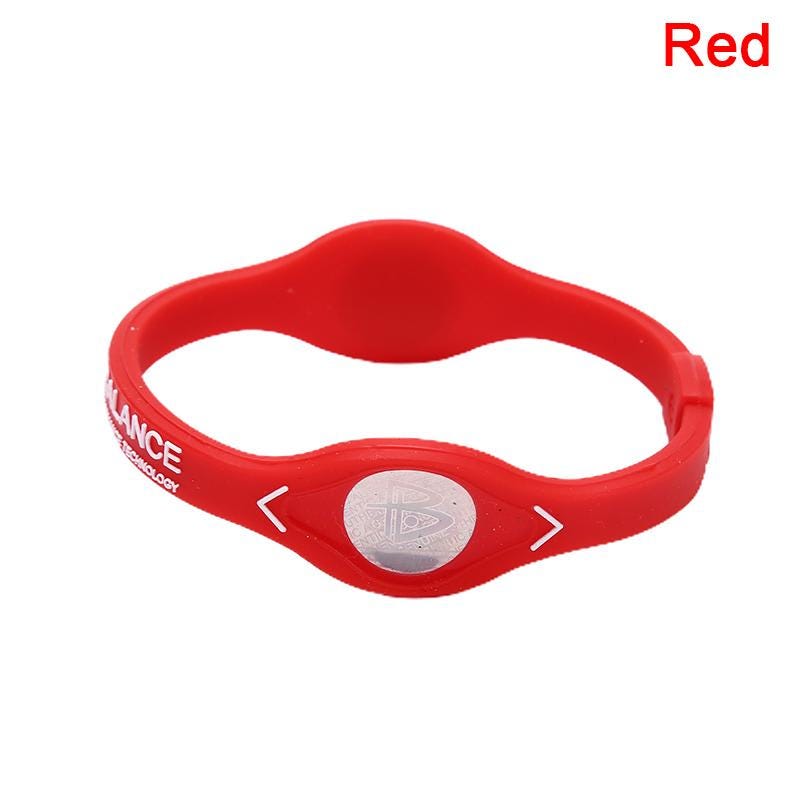
Power Balance Technologies Inc., based in Laguna Niguel, California, sold a silicone wristband containing a small mylar hologram sticker. The product retailed for roughly $29.95 to $79.95 depending on the version.classaction+2
The company’s stated claim: the hologram “resonates with and responds to the natural energy field of the body” to improve balance, strength, and flexibility. Its marketing tagline was “Performance Technology.”wikipedia+1
By 2010, the company was projecting annual revenue of $35 million, with sales reported to have grown 4,000% over three years. The bracelet was sold at sporting goods stores, pharmacies, and mall kiosks where live demonstrations were performed on shoppers. sportsbusinessjournal
Why It May Appeal
The appeal is easy to understand and worth taking seriously.
Performance anxiety is real. Athletes at every level look for edges. If elite professionals are wearing something, the reasoning goes, it might be worth trying. The bracelet was inexpensive enough that the downside felt small. At $30, the floor was low and the promise was high.
The in-store demonstration felt like direct personal evidence. Participants felt the difference in their own bodies, in real time, with no intermediary. That kind of immediate physical experience is hard to argue with, even in retrospect. Add celebrity attachment and the feeling of belonging to a group, and the product had a coherent emotional pitch.
None of that made the mechanism real. But it explains why a normal, intelligent person could walk away from a kiosk having bought the product and feeling good about it.
Red Flags Spotted
Listed in descending order of seriousness:
1. The demonstration was a physics trick, not a product test.
Independent educators and researchers identified the balance test as a force-direction illusion. Without the bracelet, the push angle was chosen to make stumbling likely. With the bracelet on, the angle shifted subtly, making balance easier. The bracelet had no role. The demonstration was constructed to produce a predetermined outcome. acefitnessyoutube
2. The core mechanism claim is unfalsifiable pseudo-science.
“Natural energy field,” “holographic resonance,” and “optimize the body’s energy flow” describe nothing biologically recognized or scientifically measurable. These terms are structured to sound technical while being immune to disproof. That structure is a classic red flag in health marketing. wikipedia
3. The company admitted it had no evidence, after the fact.
Power Balance Technologies acknowledged in writing: “We admit that there is no credible scientific evidence that supports our claims and therefore we engaged in misleading conduct.” That statement was the result of regulatory pressure, not voluntary disclosure.
4. Celebrity endorsers were paid, not volunteering.
Shaquille O’Neal and Lamar Odom were compensated spokespeople. That financial relationship was not disclosed clearly to buyers at the point of sale. When the NBA connection was later litigated, both athletes were named in consumer lawsuits. nbcsports
5. No pre-market testing was conducted.
The company reportedly reached $17 million in revenue without conducting any scientific testing to validate performance claims. The product was launched on a mechanism claim that had never been tested, and it was sold that way until regulators intervened. sportsbusinessjournal
6. Regulatory enforcement followed in two countries.
The FTC acted against a similar “Balance Bracelet” product as early as 2004, finding that ionized bracelets were no more effective than placebo at pain relief. Australia’s ACCC investigated Power Balance directly in 2010 and ordered the company to retract claims, issue corrective advertising, and offer consumer refunds. ftcyoutubedynamicbusiness
What Evidence Exists
The most favorable honest case for the product is the placebo effect.
Some users genuinely felt better, more confident, or more physically capable while wearing the bracelet. Placebo responses in athletic performance settings are documented and not trivial. They can produce measurable short-term effects on effort, perceived exertion, and confidence.
That is a real phenomenon. It is not, however, what the company was selling, and it does not justify the mechanism claim, the demonstration technique, or the price.
There is no peer-reviewed study supporting the holographic energy-field mechanism. thekeep.eiu
What Remains Unclear or Unproven
Whether the original founders believed the mechanism claim when they built the product, or whether they knew from the start that the demonstration was designed to mislead. The public record shows a company that admitted no evidence existed, but the internal communications are not public.
The full scope of undisclosed paid promotions beyond O’Neal and Odom.
Whether any follow-on products marketed with similar “resonance” or “energy field” language trace back to former Power Balance personnel or investors.
Risk Rating
Rating: High Concern
Rubric Score: 23 out of 30
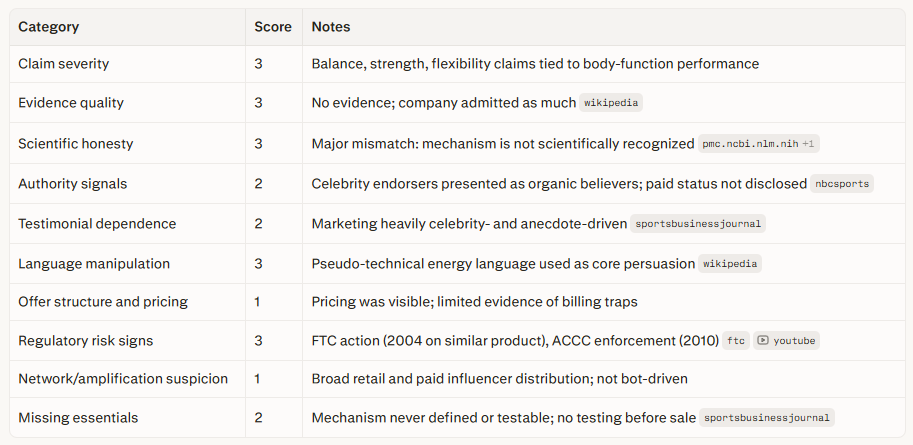
Score band: High concern (19 to 24)
Top drivers: (1) the demonstration was engineered to mislead, not test; (2) the biological mechanism is non-existent as described; (3) the company acknowledged deceptive conduct only after regulatory action.
What would change this assessment: Discovery of any credible peer-reviewed evidence showing the holographic mechanism produces measurable physiological effects under blinded conditions. No such evidence has emerged.
The product is best described as structurally deceptive: the mechanism claim, the demonstration method, and the endorsement strategy were each designed to create an impression that the evidence could not support.
Bottom Line
Power Balance sold a physical sensation as proof of a biological mechanism, used a rigged test to deliver that sensation, and credited the outcome to a piece of foil. Multiple independent clinical trials found no difference between the bracelet and a plain rubber band. The company eventually said so itself.pubmed.ncbi.nlm.nih+3
The product is no longer sold by its original manufacturer. The company declared bankruptcy in 2011 after a $57.4 million class-action settlement. But the sales pattern lives on in a category of “energy wearables” that still appear on current retail platforms using remarkably similar language.cbsnews+1
The bracelet is worth knowing because the technique it used is not retired.
Have you tried the Power Balance bracelet, or seen a similar “energy wearable” demonstrated in a store or at a health event? Did the experience feel convincing at the time? Have you found any wearable product in this category that seemed to hold up to scrutiny? And what should go into the next Daily Red Flag Report? Drop it in the comments.
This report is for informational and educational purposes only. It is not medical advice, diagnosis, or treatment.
People make better health decisions when the signal is separated from the sales pitch.