


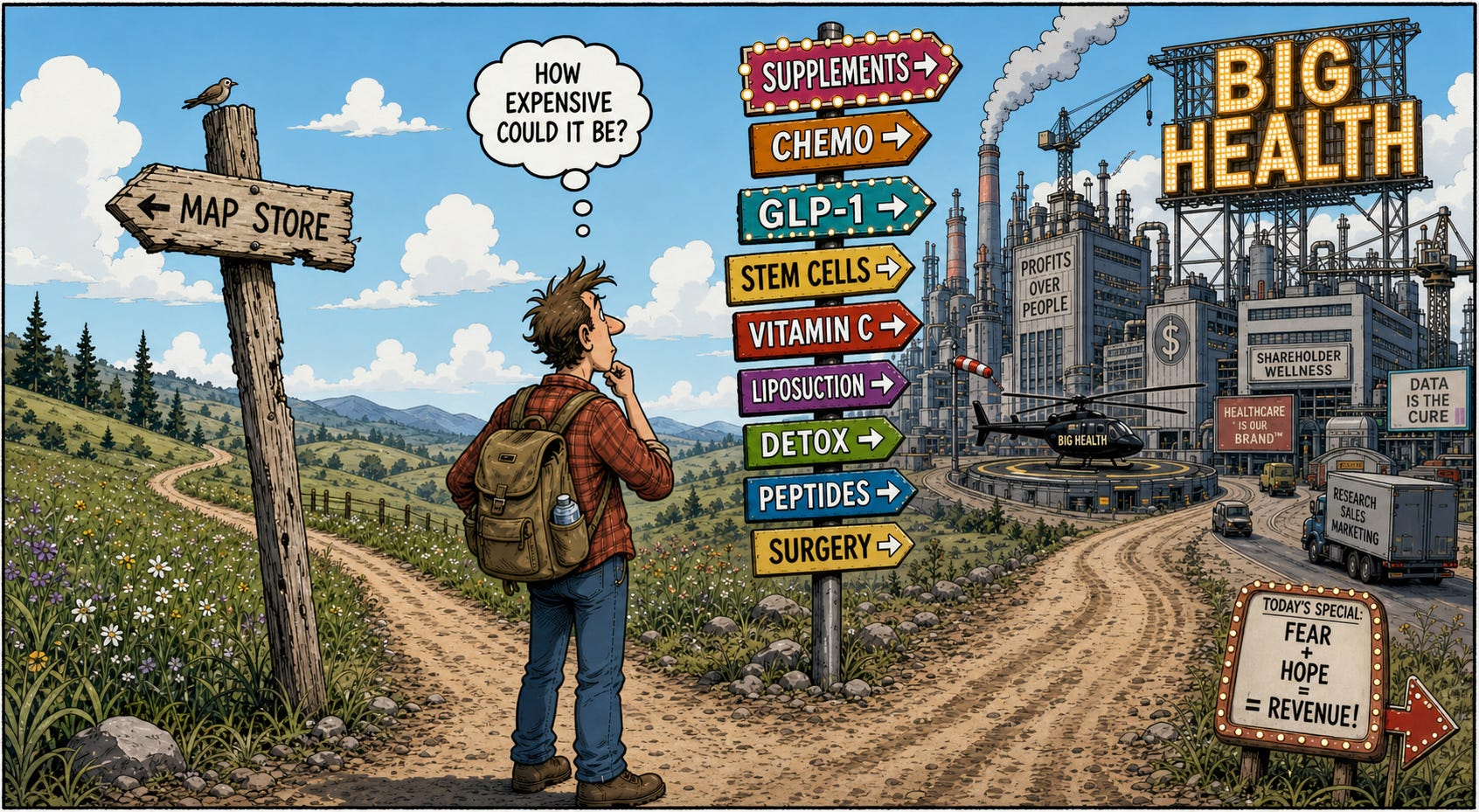
The U.S. wellness market now exceeds $500 billion in annual spend — growing 4–5% every year. The global wellness economy hit $6.3 trillion as of 2023, on track to reach 9 trillion by 2028. And yet, by almost every measurable health outcome, Americans are getting sicker, more stressed, and more broke.
That’s not a paradox. That’s a business model — and you’re the product.
If you tired of running blind and don’t want a lecture about it - feel free to skip to the end of this article for a possible solution.
The $70 Billion Supplement Lottery
More than half of all U.S. adults take dietary supplements. That’s a $70+ billion industry. Scientists at Northwestern University say most of it is wasted.
The U.S. Preventive Services Task Force reviewed 84 studies and found “insufficient evidence” that multivitamins and most supplements prevent cardiovascular disease or cancer — the two leading causes of death.
The median American supplement user spends $50/month — $600/year — with zero individualized testing guiding those choices. No baseline. No data. Just a shelf full of bottles and a lighter wallet.
That’s not wellness. That’s biochemical roulette.
The Corporate Wellness Con
Think it’s just individuals making bad choices? Organizations spend an estimated $60 billion annually on employee wellness programs.
Oxford University analyzed 46,336 workers across 233 organizations and found participants were no better off than people who didn’t participate. In some cases — like resilience training — participants actually reported worse mental health outcomes.
Forbes put a number to it: roughly $147 is lost for every dollar spent on wellness initiatives that lack personalization and data-driven direction.
Not a wellness industry. A confusion tax.
The Lifetime Bill Nobody Talks About

Here’s how the numbers play out.
An insured adult with employer-sponsored coverage can expect to spend more than $320,000 out-of-pocket over a lifetime in healthcare costs — rising to nearly $700,000 for those managing chronic illness.
Americans underestimate their own healthcare spending by approximately $76,250 over a lifetime. They’re spending as much as 145% more per year than they planned.
Meanwhile, about one-third of Americans — 82 million people — are cutting meals, borrowing money, or skipping care to pay those costs.
They’re already spending. They’re just spending blind. But they don’t have to anymore.
What a Roadmap Actually Does
Here’s where it gets interesting — because the research on personalized approaches tells a completely different story.
Engaged participants in personalized wellbeing programs saw a 14% reduction in healthcare costs year-over-year vs. industry benchmarks
Members in personalized programs showed a 23% average decrease in allowed healthcare costs vs. the broader market
Johnson & Johnson’s guided wellness ROI: $3.92 returned for every $1 invested
A structured chronic disease self-management program estimated $3.3 billion in potential savings if just 5% of adults with chronic conditions participated
The pattern is impossible to ignore: guidance converts spending into results. Without it, money evaporates.
The Map Changes Everything
The single most expensive gap in the wellness market isn’t the wrong supplement. It’s the absence of a starting point.
When you don’t know where you are, every dollar you spend is a guess. You buy what’s trending, not what’s targeted. You follow the loudest influencer, not your own biology. You stack protocols on top of protocols and wonder why nothing sticks.
One writer described the experience of millions when she said: “Six weeks in, I don’t feel dramatically better, but I do have a lighter bank account.”
Sound familiar?
The solution isn’t more products. It’s better intelligence. A roadmap — built on actual data about your body — is what turns the $500 billion guessing game into a strategy.
Because winning at health isn’t about spending more.
It’s about knowing where to start.
What If the Map Already Exists?
Here’s something the $500 billion wellness industry doesn’t advertise: your body is already broadcasting information. Constantly.
Every cell in your body operates on electromagnetic frequencies — healthy tissue runs one pattern, stressed or compromised tissue runs another. This isn’t fringe theory. It’s the same basic principle behind the EEG scans that read your brain waves and the EKG that reads your heart. Your body communicates in frequencies. The question is whether anyone is listening.
Nikola Tesla understood this over a century ago. His research into electromagnetic resonance — the idea that every physical system has a natural frequency it vibrates at — laid the groundwork for technologies that are only now being applied to human health. Russian scientists built on Tesla’s principles for decades, developing scanning systems that could read the body’s electromagnetic output and map it against known healthy frequency signatures. That research became the foundation of modern bioresonance technology.
Bioresonance scanning is how you listen.

One session scans your body across 150 areas — organs, tissues, hormones, nutritional status, toxin load — and maps the patterns together into a single whole-body picture. Not a diagnosis. Not a prescription. A starting point. The kind of baseline that turns $600 a year in random supplements into a targeted strategy. The kind of map that turns “I don’t know why I feel this way” into a list of specific questions to bring to your next appointment.
No needles. No labs. Comfortable enough for the whole family.
That’s what a map looks like.
Want to see one before you commit to anything?
Download a free sample Scan & Review report: